
Haría is Lanzarote’s green northern counterpoint to the island’s stark volcanic south. Set in a valley scattered with palms and white houses, it offers a slower base close to César Manrique’s final home, dramatic viewpoints, volcanic caves and some of the island’s most attractive northern coastal stops.
Choose Haría if you want quiet evenings, village atmosphere and easy access to north Lanzarote. It is less convenient for nightlife and the southern resort beaches, but excellent for travellers who value landscape, architecture and small-scale local life.
Why visit Haría?
Haría adds a different dimension to a Lanzarote holiday because it gives you a specific reason to slow down rather than simply moving between headline attractions. The best visits combine one or two priorities with enough unplanned time for the local landscape, cafés, viewpoints or waterfront.
If this is your first trip to Lanzarote, use our Lanzarote travel guide together with the wider island guides linked below. That makes it easier to decide whether Haría should be a day trip, an overnight stop or a longer base.
Best things to do in Haría
Walk through the palm-filled village
Haría is often called the Valley of a Thousand Palms, and the greenery is immediately noticeable by Lanzarote standards. The central streets are compact, with a plaza, cafés and traditional white architecture softened by vegetation.
Morning and late afternoon are the best times for a quiet walk. Day visitors often arrive in short waves, while the village feels much more local outside those periods.
Discover César Manrique’s connection to Haría
César Manrique spent the later part of his life in Haría, and his relationship with the landscape is an important part of understanding northern Lanzarote. If you visit his house museum or other Manrique sites, allow enough time to see the spaces rather than rushing through them as a checklist.
Pair Haría with Jameos del Agua, Mirador del Río or the Cactus Garden on different days or in a carefully planned north-island loop.
Explore Volcán de la Corona and the volcanic north
The Corona volcano dominates the northern landscape and is connected geologically to the long volcanic tube system that includes Cueva de los Verdes and Jameos del Agua. The official tourism board describes a hiking route toward the crater.
Check trail conditions and protect yourself from sun and wind. Lanzarote’s open volcanic terrain can feel deceptively cool when the breeze is strong.
Reach Arrieta, Punta Mujeres and Caletón Blanco
Haría municipality includes some of Lanzarote’s most appealing coastal stops. Arrieta has a family beach, Punta Mujeres has natural pools, and Caletón Blanco combines pale sand with turquoise shallows on the road toward Órzola.
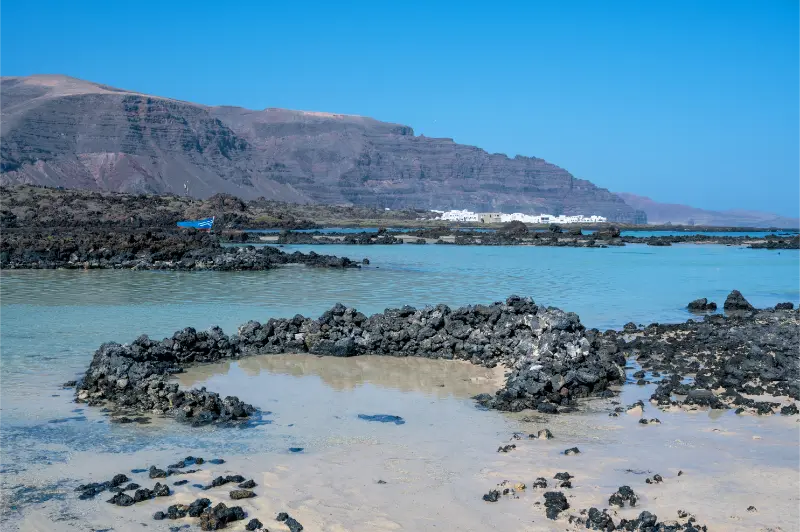
Do not assume every beautiful cove is safe in every condition. Choose swimming spots according to tide, wind and local advice.
Where to stay in Haría
Accommodation location matters in Haría. Before booking, decide whether your priority is walking access, a sea or mountain view, simple parking, or the ability to leave early for day trips around Lanzarote.
Read recent reviews for noise, gradients, stairs and actual parking arrangements. Canary Island topography often makes two properties that look equally convenient on a flat map feel very different once you arrive.
- Haría village: best for quiet atmosphere, walking and a rural base.
- Arrieta or Punta Mujeres: better if daily sea access matters.
- Costa Teguise: more services and resort facilities while remaining within reach of the north.
Getting around and parking
A rental car is the most practical way to use Haría as a base because attractions and beaches are spread across the north. Buses exist but require more schedule planning. Roads are generally good, yet cyclists and narrow village streets require patience.
Parking in Haría is usually manageable if you use public areas and walk a few minutes. At major north-island attractions, arrive earlier than peak excursion traffic. At natural coastal stops, never create a new parking track across volcanic ground.
Driving times around Lanzarote should be treated as estimates, especially when mountain roads or popular visitor areas are involved. Leave margin between activities and avoid building a day in which every stop depends on arriving at an exact minute.
What and where to eat
Haría is well suited to relaxed lunches built around local produce, goat cheese, fish and Lanzarote wines. The village market can add interest on the appropriate day, but confirm current operating times before structuring the entire itinerary around it.
A useful approach is to choose one meal around local products rather than spending the entire trip chasing a fixed restaurant list. Opening days, ownership and quality can change, while markets, bakeries and small family-run places often become the most memorable stops.
For a broader introduction to the archipelago’s flavours, see our Canary Islands food guide. It covers papas arrugadas, mojo, island cheeses, fish, wines and regional differences.
Best time to visit Haría
The north is often a little cooler and can receive more cloud than Playa Blanca, which helps explain the greener landscape. Spring and autumn are excellent for walking, while winter remains mild. Summer is dry and bright, but wind and sun exposure can be intense on open terrain.
Microclimates matter across the Canary Islands. Check the forecast for the exact coast or elevation you are visiting rather than relying only on the weather at your hotel. Carrying a light layer and sun protection at the same time is often sensible.
Best day trips from Haría
Jameos del Agua, Cueva de los Verdes, Mirador del Río, Órzola and La Graciosa ferry connections are all natural north-Lanzarote excursions. Teguise also fits easily, while Timanfaya and the south deserve their own day.

One of the easiest ways to improve a Lanzarote itinerary is to group nearby places geographically. A day with two strong stops and an unhurried lunch is usually more enjoyable than a route designed only to maximise the number of pins on a map.
A practical one-day itinerary for Haría
Start early in Haría so you can enjoy the main sight, beach, trailhead or historic centre before the busiest part of the day. Use the morning for the experience that matters most and keep the second half of the day flexible.
Plan lunch somewhere that fits naturally with the route rather than driving across the destination for a single famous restaurant. In the afternoon, add one contrasting element such as a viewpoint, swim, short walk, museum or nearby village.
If your day contains a reservation, regulated trail or boat departure, build everything else around that fixed commitment. Weather, parking and road conditions are easier to manage when the itinerary has breathing room.
Practical tips that make the visit easier
- Start early: popular parking areas and trailheads are easier before the main day-trip rush.
- Carry water: wind and mild temperatures can hide dehydration in volcanic landscapes.
- Use proper footwear: cobbles, lava, steep streets and wet forest roots need more grip than resort pavements.
- Check official access information: protected areas, boat services and regulated routes can change.
- Keep a backup plan: ocean swell, cloud, wind or road closures can affect an otherwise sunny day.
- Respect local life: do not block private entrances, farm access or narrow village streets for a photograph.
Common mistakes to avoid
The most common mistake is trying to combine Haría with too many distant attractions. Distances on Lanzarote can look small, but curves, traffic, parking and viewpoint stops add time. A route that seems efficient on a screen can become a day spent mostly in the car.
Another mistake is relying on old access information for protected landscapes. Visitor-management rules in the Canary Islands increasingly use reservations, controlled transport or temporary closures. If one site is the main reason for your day, verify it on the official website shortly before departure.
Frequently asked questions about Haría
How long do you need in Haría?
Allow at least half a day for a focused visit. A full day is better if you want to add a beach, long lunch, hike or nearby village. Staying overnight makes sense when Haría is also a base for exploring this part of Lanzarote.
Do you need a car for Haría?
Not always. Public transport may be enough for the main centre or beach, while a car becomes more useful for rural viewpoints and multi-stop itineraries. Check whether parking complexity outweighs the convenience for your specific plan.
Is Haría good for families?
It can be, but the answer depends on the exact activity. Beaches, promenades and short cultural visits are very different from demanding hikes or exposed viewpoints. Match the day to children’s ages, mobility and the current weather.
Should you book anything in advance?
Reserve limited-capacity hikes, boat trips, major attractions and anything with a fixed entry time. For ordinary walking, beaches and local meals, flexibility is often more useful than booking every hour.
How to make a longer stay work
Alternate active days with easier local time. A mountain drive, long hike or boat excursion can be followed by a late breakfast, market visit and short coastal walk. This rhythm prevents a one-week holiday from feeling like a sequence of early alarms.
Choose one geographic area for each major excursion. If you repeatedly cross the same island from end to end, the accommodation base may not match the itinerary. Splitting a longer stay between two areas can reduce driving and reveal different evening atmospheres.
Keep one half-day deliberately unplanned. Good weather, a local recommendation, an unexpectedly inviting beach or simple fatigue can all justify changing the plan. Flexibility is one of the advantages of organising an independent Canary Islands trip.
Small details that improve the trip
Download offline maps and save your accommodation address somewhere that works without mobile data. In historic centres and mountain areas, navigation apps sometimes propose narrow streets that are technically passable but uncomfortable for visitors. Follow local signs and accommodation arrival instructions.
Sun protection matters even on cool, windy or cloudy days. At altitude and beside the Atlantic, conditions can mask how strong the ultraviolet exposure is. Carry sunscreen, a hat and a light layer rather than dressing only for the temperature at breakfast.
Use current local advice as part of the plan. Accommodation staff, visitor centres and official transport services can tell you whether a parking area is already full, which coast is calmer, or whether weather has changed access to a trail.
Final planning advice
Haría is most rewarding when you let it be a destination rather than another box to tick. Build the day around one or two strong experiences, then leave room for the café, side street, view or swim that was not on the original schedule.
Continue planning with Teguise guide and La Graciosa guide. These related guides help turn individual articles into a realistic route rather than a collection of disconnected attractions.
For current local information, opening details and access updates, consult the official Lanzarote tourism guide to Haría before travelling.