
La Graciosa is the simplest Canary Island on paper and one of the easiest to plan badly. There are no large resorts, no airport and almost no conventional road network. You arrive by sea from northern Lanzarote, step into sandy streets in Caleta de Sebo and immediately have to adjust to a slower rhythm. That is the point.
The island is excellent as a day trip, but staying one or two nights changes the experience. When excursion boats leave, Caleta de Sebo becomes quieter and the evening light across the Risco de Famara feels completely different. If your Canary Islands holiday is already built around Lanzarote, La Graciosa is one of the most natural additions.
Why visit La Graciosa?
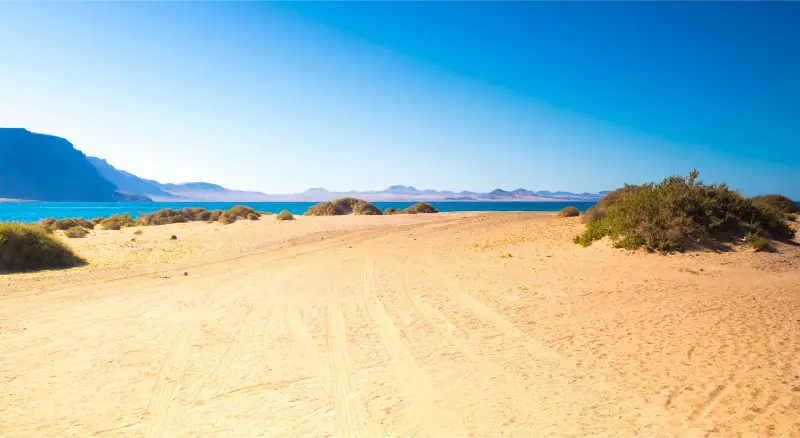
La Graciosa is part of the Chinijo Archipelago protected environment north of Lanzarote. It is characterised by golden beaches, turquoise water, volcanic cones and unpaved streets. The official Lanzarote tourism authority presents it as a low-key destination for travellers willing to adapt to a fragile natural landscape rather than expecting the landscape to adapt to them.
The attraction is not a long list of monuments. It is the ability to cycle on sandy tracks, walk to a beach with almost no development, eat fresh fish in Caleta de Sebo and watch the sun fall behind the volcanic silhouettes.
- Best for: beaches, couples, walkers, cyclists and slow travel.
- Best length: a full day for a first taste; one or two nights for atmosphere.
- Main village: Caleta de Sebo.
- Transport: walking, bicycle and authorised 4×4 taxi services.
How to get to La Graciosa
La Graciosa is reached by ferry from Órzola on the north coast of Lanzarote. Regular passenger services run to Caleta de Sebo, with frequencies varying by season and demand. The crossing is short, but wind and sea conditions can affect comfort and schedules.
If you are staying in Puerto del Carmen, Playa Blanca or Costa Teguise, remember that the trip begins with a road transfer to Órzola. Leave enough time for parking, ticket collection and boarding. Check official Lanzarote maritime transport information and the ferry operator directly before travelling.
Do not schedule the final ferry back to Lanzarote immediately before a flight. A separate night in Lanzarote is the safer choice when an international departure matters.
Caleta de Sebo
Caleta de Sebo is the social and practical centre of the island: ferry port, accommodation, restaurants, small shops, bicycle rental and the starting point for most excursions. Streets are sandy, distances are short and footwear quickly becomes optional for many visitors.
Stay here if you want to experience the island after day trippers leave. Accommodation is limited compared with Lanzarote, so book early during school holidays and weekends. Bring any medication or specialist items you need rather than assuming the small local shops will stock everything.
Las Conchas: spectacular, but not a swimming beach
Las Conchas on the north side is one of the island’s most beautiful beaches, with pale sand and views towards Montaña Clara and Alegranza. It is also exposed to Atlantic swell. The official Canary Islands tourism information specifically warns that waves can be strong and bathing is not recommended.
Treat Las Conchas as a landscape and beach-walk destination rather than a guaranteed swim. Bring plenty of water and sun protection because there is little shade. Reaching it by bike or on foot is part of the experience, but the sandy tracks can be more tiring than their distance suggests.
La Francesa and the south coast
Playa de La Francesa is a more sheltered option south of Caleta de Sebo and a favourite for day visitors and boat excursions. The walk from the village is straightforward in normal conditions, and the views back towards Lanzarote’s cliffs are excellent.
Continue towards Montaña Amarilla if you want a longer outing, but remember that heat and wind amplify effort on the exposed terrain. There are no beach clubs waiting at the end of every trail; carry water, snacks and a bag for your waste.
Pedro Barba and the quieter north-east
Pedro Barba is the island’s second settlement and feels very different from Caleta de Sebo. It has limited visitor services and should be approached as a quiet residential area rather than an attraction. The surrounding tracks and coastline offer a sense of remoteness that is increasingly rare in Europe.
Respect private property and avoid treating doorways, walls and small lanes as photo sets. La Graciosa’s charm depends heavily on visitors behaving like guests.
Cycling La Graciosa
Bicycle rental is popular because distances are manageable and there are no conventional paved roads. However, “flat island” does not mean effortless cycling. Sand, corrugations, wind and heat can make a route far harder than the kilometre count suggests.
Choose a well-maintained bike, test brakes and tyre pressure before leaving and ask the rental shop which tracks are currently suitable. E-bikes can reduce effort but do not remove the need for careful handling on loose surfaces. Carry a repair plan and enough water to walk back if necessary.
Walking and hiking
Walking is the most natural way to understand the island, especially if you stay overnight and can start early. Popular objectives include the south coast, Las Conchas and routes around volcanic cones. Avoid cutting across protected terrain just because a map shows a straight line.
There is almost no shade. A hat, sunscreen and more water than you would carry for the same distance in a cool climate are essential. Wind can disguise how strong the sun feels.
Where to stay and whether to sleep on the island
Nearly all practical accommodation is in Caleta de Sebo. A day trip is enough if you mainly want a ferry ride, a beach and lunch. Stay overnight if you value quiet evenings, sunrise, photography, cycling before the heat or simply the novelty of waking up on a small island with sandy streets.
If you are planning La Graciosa as part of a longer Lanzarote holiday, read our Lanzarote travel guide. A night on La Graciosa fits particularly well into a road trip based in the north of Lanzarote.

Food and supplies
Caleta de Sebo has restaurants serving fish, rice dishes and Canarian staples, along with small shops for basics. Opening hours and availability are naturally more limited than on Lanzarote. If you have strict dietary requirements, bring a backup snack or simple meal ingredients.
Do not overpack for a one-night stay. A small daypack with water, sun protection, swimwear, a light layer for the ferry and essential toiletries is usually enough.
A perfect one-day plan
- Morning: early ferry from Órzola and breakfast or coffee in Caleta de Sebo.
- Late morning: walk or cycle towards La Francesa and the south coast.
- Lunch: return to Caleta de Sebo for a relaxed meal.
- Afternoon: choose a 4×4 taxi excursion, short bike ride or nearby beach according to heat and wind.
- Evening: ferry back to Lanzarote—or stay overnight and enjoy the island after the day-trip crowds leave.
A relaxed two-night plan
- Day 1: arrive by late morning, explore Caleta de Sebo and walk to La Francesa.
- Day 2: early cycle or taxi excursion to Las Conchas and northern viewpoints; long lunch and sunset.
- Day 3: slow breakfast, a final swim near the village and ferry to Órzola.
Best time to visit
La Graciosa is enjoyable year-round, but spring and autumn combine warm weather with comfortable walking conditions. Summer can be hot and bright, while winter days are mild but wind and Atlantic conditions can affect ferry comfort and beach plans.
Wind matters at least as much as temperature. Check the forecast for both Lanzarote and the marine crossing, and keep your day flexible if cycling is central to the plan.
What to bring
- High-SPF sunscreen, hat and sunglasses.
- At least one large bottle of water per person for longer walks or rides.
- Comfortable shoes that cope with sand and volcanic gravel.
- A light wind layer for the ferry and evenings.
- Power bank, especially if your phone is your map and camera.
- A small rubbish bag so nothing is left in protected areas.
Common mistakes
- Treating Las Conchas as a guaranteed swimming beach despite strong Atlantic surf.
- Underestimating cycling effort on sand and in wind.
- Arriving with no water because the island “looks small”.
- Booking the last possible ferry connection before an important flight.
- Walking off marked tracks through protected terrain.
- Expecting nightlife, shopping or resort facilities.
Practical tip: La Graciosa is best when you remove one activity from your plan. The island’s value is the empty time between the beach, the bike ride and the ferry.
Final advice
La Graciosa is not a mini Lanzarote. It is a protected, low-infrastructure island where the absence of asphalt and big development is the product. Travel light, move slowly and use the sea conditions—not a fixed checklist—to decide what kind of beach day you have.
For current local information, consult the official Lanzarote tourism page for La Graciosa. If this is part of a multi-island trip, our Canary Islands island-hopping guide explains how to combine it with Lanzarote and Fuerteventura.