
La Palma rewards travellers who choose accommodation around the hikes and landscapes they actually want to see, because mountain roads make straight-line distances misleading. Choosing the right base matters because two stays on the same island can feel like completely different holidays. The useful question is not simply which town is most famous, but where you will spend mornings, how often you plan to drive, what kind of evenings you enjoy and how much convenience you want within walking distance.
If this is your first trip, read our La Palma travel guide alongside this article. The island guide explains the bigger picture; this page is deliberately focused on accommodation geography, day-to-day convenience and the trade-offs between the main bases.
Quick answer: the best areas to stay in La Palma
- Santa Cruz de La Palma — best for history, restaurants and car-free evenings
- Los Cancajos and Breña Baja — best for easy logistics and short stays
- Los Llanos de Aridane — best for exploring the west and local town life
- Tazacorte and Puerto de Tazacorte — best for the west coast and sea views
- Fuencaliente and Los Canarios — best for volcanoes, wine and quiet nights
- Puntagorda and the north-west — best for stargazing and rural slow travel
The best places to stay in La Palma
Santa Cruz de La Palma
Santa Cruz de La Palma is the island’s most attractive urban base, with historic streets, balconies, restaurants, a seafront and ferry connections. It is ideal for travellers who want to explore during the day and return to a real town at night. Parking in the centre requires more thought than at a resort, so accommodation with a clear parking plan is valuable if you rent a car.
Best for: historic atmosphere and restaurant choice. Think about the return journey as much as the outward one: a base that feels perfect at 10:00 can feel very different after a long road-trip day, a late dinner or a windy afternoon.

Los Cancajos and Breña Baja
Los Cancajos is one of the simplest bases for a first visit because it sits close to the airport and Santa Cruz while still providing a coastal holiday setting. It works well for families, late arrivals and travellers who want to reduce transfer time. The location is convenient rather than dramatic, but that convenience can be a major advantage on a seven-night trip.
Best for: airport convenience and an easy first base. Think about the return journey as much as the outward one: a base that feels perfect at 10:00 can feel very different after a long road-trip day, a late dinner or a windy afternoon.
Los Llanos de Aridane
Los Llanos is the practical centre of the western side, with shops, restaurants and road connections toward the Caldera de Taburiente area, Tazacorte and volcanic landscapes. It suits hikers who prefer returning to a lively inland town instead of a beach resort. Because the island’s weather can differ east and west, staying here also gives easy access to sunnier western conditions on many days.
Best for: hikers, west-coast access and local services. Think about the return journey as much as the outward one: a base that feels perfect at 10:00 can feel very different after a long road-trip day, a late dinner or a windy afternoon.
Tazacorte and Puerto de Tazacorte
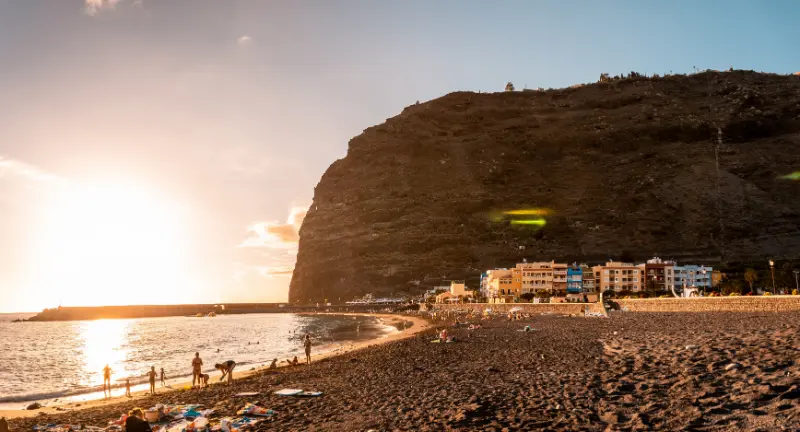
Tazacorte combines banana-growing landscapes, coastal light and access to one of the island’s main west-coast seaside areas. It is a good choice for travellers who want the warmer, drier feel of the west and who plan to mix hiking with relaxed afternoons near the sea. Check the exact address carefully because the municipality includes locations at different elevations.
Best for: sunny west-coast days and sea views. Think about the return journey as much as the outward one: a base that feels perfect at 10:00 can feel very different after a long road-trip day, a late dinner or a windy afternoon.
Fuencaliente and Los Canarios
The south around Fuencaliente is ideal for travellers fascinated by volcanic landscapes, vineyards, salt pans and the island’s more austere scenery. Accommodation tends to be quieter and more dispersed than in Santa Cruz or Los Llanos, so a car is strongly recommended. It is a rewarding two- or three-night base for photographers and walkers who enjoy early starts and peaceful evenings.
Best for: volcanoes, wine and solitude. Think about the return journey as much as the outward one: a base that feels perfect at 10:00 can feel very different after a long road-trip day, a late dinner or a windy afternoon.
Puntagorda and the north-west
The north-west offers some of La Palma’s quietest rural stays, with deep ravines, small settlements, night skies and a slower daily rhythm. Distances on the map are deceptive because roads curve around the terrain. Choose this area when seclusion is a goal, not when you expect to visit Santa Cruz every evening. A rural house with a terrace can be part of the experience rather than merely a place to sleep.
Best for: stargazing, rural landscapes and longer stays. Think about the return journey as much as the outward one: a base that feels perfect at 10:00 can feel very different after a long road-trip day, a late dinner or a windy afternoon.
One base or two?
For a seven-night holiday in La Palma, one well-chosen base is usually enough unless your priorities sit at opposite ends of the island. Split stays make more sense from ten nights upward, or when you deliberately want two contrasting experiences such as resort convenience followed by a rural or historic base. Moving hotels every two or three nights looks efficient on paper but often consumes the best part of a morning once packing, check-out, luggage and check-in are included.
Hotel, apartment or rural stay?
Hotels are simplest when you value breakfast, reception, housekeeping and a pool. Apartments become attractive for families and longer stays because a kitchen and washing machine reduce daily friction. Rural houses and small inland properties can be the most memorable choice for walkers and road-trippers, but they require more attention to evening meals, road access and late arrival. Always read the most recent reviews for practical details rather than relying only on the property description.
How to plan a better La Palma stay
A good La Palma itinerary is built around geography rather than a list of attractions. Put places that share the same side of the island into the same day, leave room for weather changes, and avoid crossing the island twice simply because two famous stops looked close on a map. The most satisfying trips usually alternate a fuller sightseeing day with a lighter beach, town or food day. That rhythm gives you enough flexibility to stay longer somewhere that genuinely deserves it.
Before each day, save the location of your accommodation, a supermarket, one fuel station and one alternative activity offline. Mobile coverage is generally good, but mountain roads, ravines and remote coastlines can create short gaps. If wind, cloud or ocean conditions make the original plan unattractive, change the order instead of forcing it. This is particularly useful in the Canary Islands, where conditions can differ noticeably between coasts and elevations on the same day.
Driving, parking and public transport
A rental car gives the greatest freedom for this kind of trip, but it is not automatically necessary for every traveller. Resort areas and island capitals can work well without one, especially if your holiday is centred on beaches, restaurants and organised excursions. If you do drive, choose legal parking even when a viewpoint or beach looks only a few metres away. Narrow roads and soft shoulders are not good places to improvise. In towns, a slightly longer walk from a proper car park is usually less stressful than circling the historic centre.
For broader transport planning, use our Canary Islands without a car guide and driving in the Canary Islands guide. Bus networks are useful for many urban and resort journeys, but timetables and frequencies vary by island and day, so confirm the current schedule before building a tight connection around the last service.
What to check before booking accommodation
- The exact walking route to the beach or town centre, including gradients and stairs.
- Whether parking is private, public, guaranteed or simply described as available nearby.
- Noise from roads, nightlife, hotel entertainment or construction mentioned in recent reviews.
- Air-conditioning, heating or ventilation that matches the season and elevation.
- Late check-in arrangements if your flight or ferry arrives after reception hours.
- Cancellation conditions and any deposits or locally payable charges.
The best-value room is not always the cheapest room. On La Palma, saving a small amount can cost much more in daily driving, taxis or lost time if the base is wrong for your priorities. Decide first whether your holiday is mainly about beaches, hiking, towns, nightlife, family convenience or quiet scenery; then compare properties only inside the areas that fit that goal.
A final practical rule
Imagine three ordinary days on La Palma: breakfast, the first activity, the return in late afternoon and dinner when you are tired. If the accommodation makes those ordinary moments easy, it is probably a strong choice. A beautiful view is valuable, but a base that repeatedly adds forty minutes of driving or a steep climb can quietly dominate the holiday.
Best strategy: choose the area first and the property second. On La Palma, location usually has a bigger effect on the rhythm of the trip than an extra hotel star.