
You can visit Tenerife without renting a car, but the quality of the trip depends much more on where you stay. A hotel that looks cheap on a map can become expensive and frustrating if every beach, restaurant or excursion requires a taxi. The best car-free base is therefore not simply the prettiest town: it is the place that lets you do most of your normal holiday routine on foot and uses public transport only for the days that genuinely need it.
Tenerife has the strongest public-transport network of these five islands. TITSA buses cover the main resort corridors, both airports and many towns, while the tram links Santa Cruz and La Laguna. That does not make every mountain trailhead easy without a car, but it gives car-free travellers far more options than the island’s size might suggest. This guide focuses on accommodation location, airport access, walking, buses, organised excursions and realistic day trips. For the complete network and ticket basics, also read our Tenerife public transport guide and the broader Canary Islands without a car guide.
Quick answer: the best places to stay in Tenerife without a car
| Base | Best for | Main limitation |
|---|---|---|
| Los Cristianos | The strongest all-round car-free resort base | Most versatile |
| Costa Adeje | Best for polished resort infrastructure, beaches and tour pick-up convenience | Longer trips to the opposite side of the island |
| Puerto de la Cruz | The best northern car-free base if you prefer a real town atmosphere, restaurants, black-sand coast and easier access to the Orotava Valley | Resort convenience |
| Santa Cruz / La Laguna | Best for urban travel, culture and public transport | Less useful for remote hiking |
For a first car-free trip, choose the base where you can walk to a beach or town centre, buy groceries, eat dinner and reach a bus stop without a daily taxi. That simple rule matters more than the distance to every attraction on your sightseeing list.
What makes a good car-free base?
- A walkable centre with restaurants, supermarkets and pharmacies
- A direct or simple airport connection
- A useful bus station or several frequent routes
- Beaches or everyday attractions reachable on foot
- Tour pick-up points for the difficult mountain or remote-coast days
- Enough evening choice that you are not forced into taxis after dinner
The goal is not to prove that every corner of the island can be reached by bus. It is to design a holiday where public transport does the repetitive journeys well and you solve the occasional awkward day with a tour, taxi or transfer. That is usually cheaper and more relaxing than booking poor-value accommodation simply because it includes parking you will not use.
Best bases in detail
Los Cristianos
The strongest all-round car-free resort base. It is walkable, has beaches, a major bus station, ferry departures to the western islands and a huge choice of organised excursions. It works especially well if you want to combine easy beach days with Teide, whale-watching or La Gomera without driving.
Choose Los Cristianos if you want the majority of your evenings and easy days to happen close to the hotel. Before booking, check the walking route from the exact property to the bus stop and waterfront: a “500-metre” distance can feel very different when the accommodation sits on a steep hill or across a fast road.
Costa Adeje
Best for polished resort infrastructure, beaches and tour pick-up convenience. You can walk between many coastal areas, buses connect the south, and excursions commonly collect from the main hotel zones. The trade-off is that exploring the north independently takes longer.
Choose Costa Adeje if you want the majority of your evenings and easy days to happen close to the hotel. Before booking, check the walking route from the exact property to the bus stop and waterfront: a “500-metre” distance can feel very different when the accommodation sits on a steep hill or across a fast road.
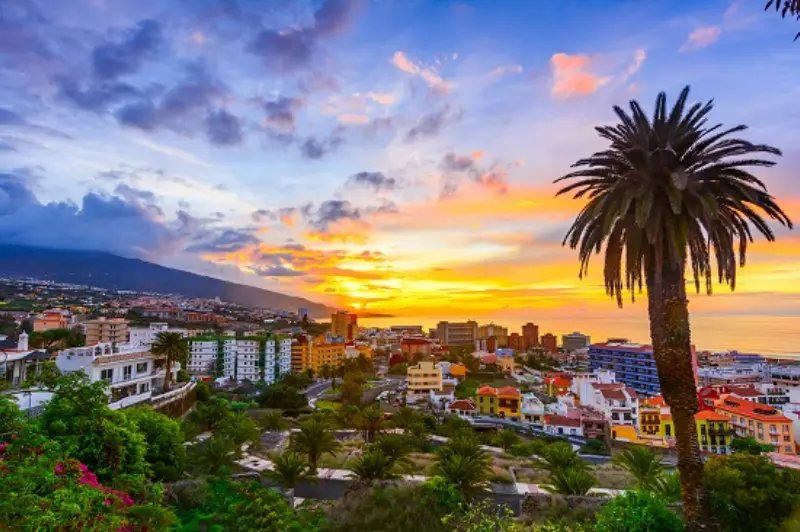
Puerto de la Cruz
The best northern car-free base if you prefer a real town atmosphere, restaurants, black-sand coast and easier access to the Orotava Valley. Bus connections are useful, but some hiking days still work better as organised transfers or taxis.
Choose Puerto de la Cruz if you want the majority of your evenings and easy days to happen close to the hotel. Before booking, check the walking route from the exact property to the bus stop and waterfront: a “500-metre” distance can feel very different when the accommodation sits on a steep hill or across a fast road.
Santa Cruz / La Laguna
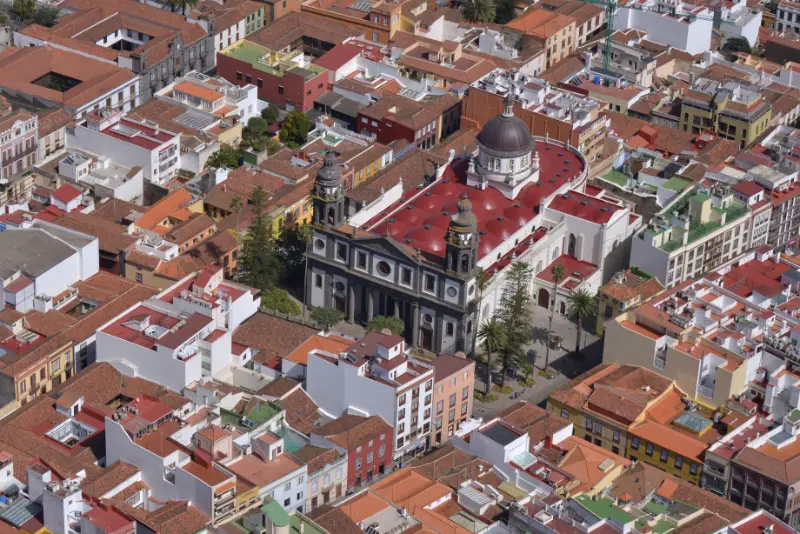
Best for urban travel, culture and public transport. The tram makes the two cities easy to combine, and bus connections radiate across the island. This is less of a classic beach-resort choice but excellent for travellers who prioritise towns, food and day trips.
Choose Santa Cruz / La Laguna if you want the majority of your evenings and easy days to happen close to the hotel. Before booking, check the walking route from the exact property to the bus stop and waterfront: a “500-metre” distance can feel very different when the accommodation sits on a steep hill or across a fast road.
Where a no-car itinerary becomes difficult
Remote Anaga trailheads, Teno back roads, high-altitude Teide trailheads and beaches far from the main resort corridors are where a no-car itinerary becomes slower or requires a tour/taxi solution.
This is where organised excursions earn their place. A good tour is not a failure of independent travel: it can replace a day of complicated connections, parking uncertainty and trailhead logistics. Compare the total cost for two people before assuming a rental car is automatically cheaper.
Airport transfers without a rental car
TITSA is the main public-transport reference for this island. Check the official site before travel because routes, stop locations and frequencies can change: official TITSA information. If your flight arrives late, lands on a Sunday/holiday timetable or carries a lot of luggage, compare a pre-booked transfer or taxi with the bus rather than building the entire trip around the cheapest theoretical option.
Can you reach the main sights by bus?
Some headline sights are easy to reach, others are only technically reachable. The important distinction is frequency. A bus that runs several times per hour gives you freedom; a route with only a few departures can turn a simple visit into an all-day commitment. Always build the return journey first, then choose the outward departure.
For mountain and protected-area days, check access rules separately. A bus stop near a trail does not guarantee that the trail is open, that a timed permit is available or that weather conditions are suitable. Keep one town, beach or museum day as a weather backup.
Best strategy for a 7-day car-free holiday
- Day 1: arrive, learn the neighbourhood and buy groceries
- Day 2: walkable beach or city day
- Day 3: one organised full-day excursion to the hardest major sight
- Day 4: independent bus day to a well-connected town
- Day 5: slow local day with no major transport
- Day 6: second excursion or ferry/boat activity
- Day 7: flexible weather day and simple airport transfer
This rhythm prevents the common mistake of spending six consecutive days watching timetables. Car-free travel works best when only two or three days depend on long-distance transport and the rest exploit the strength of the base you deliberately chose.
How to choose accommodation
Use our where to stay in Tenerife guide to compare resort style, then filter accommodation by walking distance to the transport hub rather than by municipality name alone. If you are travelling with children, mobility limitations or heavy luggage, check elevation and pavement quality as carefully as distance.
- Prefer properties within an easy walk of a useful stop or station
- Read recent reviews for hill access and noise, not only room quality
- Check supermarket opening hours if self-catering
- Confirm whether tour operators collect from your exact zone
- Avoid isolated villas unless you are comfortable using taxis
- Save the accommodation pin and nearest stop offline before arrival
Budget: bus, taxi, transfer or occasional car hire?
A no-car holiday is not automatically the cheapest. Add airport transfers, two or three taxis, guided tours and any ferry transfers before comparing it with a small rental car. For one traveller, buses and tours often win. For a family of four, occasional private transfers may close the gap quickly. The right answer depends on the itinerary, not on a fixed rule.
Common mistakes
- Booking a hilltop property because it looks close to the beach on a map
- Assuming every bus runs late into the evening
- Planning a remote hike before checking the return connection
- Changing hotel repeatedly just to reduce one day-trip journey
- Using taxis for every meal because the accommodation area is isolated
- Treating airport distance as the only measure of convenience
Frequently asked questions
Do you really need a car in Tenerife?
No, not for a well-designed resort or city stay. You need a car mainly for flexibility: remote beaches, mountain trailheads, spontaneous road trips and combining several distant stops in one day.
Is public transport reliable enough for airport days?
Usually yes on the main corridors, but flight days deserve more margin than ordinary sightseeing. Check the official operator timetable shortly before travel and use a taxi or transfer if a missed connection would put the flight at risk.
What is the best option for families?
Choose the most walkable base, not the most scenic isolated accommodation. Families benefit disproportionately from being able to reach dinner, the beach and a supermarket without loading children into transport several times a day.
Can I combine two bases without a car?
Yes, but only when the transfer is simple and the second base gives you a genuinely different part of the island. For a one-week holiday, one strong base plus day trips is usually easier.
Final advice
The best place to stay in Tenerife without a car is the one that makes your ordinary day easy. Choose a base where you can walk to food, the waterfront and useful transport; use buses for predictable corridors; and spend money selectively on the difficult mountain or remote-coast days. That approach produces a much more relaxed car-free holiday than trying to prove that every attraction can be reached independently.
The Booking.com button is an affiliate link. If you book after following it, WelcomeToCanaries may receive a commission at no extra cost to you.